
MY BLOG POSTS
Career vs. Calling
“How do I know what God wants me to do?” This is a question I hear a lot, a question that is at the heart of Right Where I Belong. And it’s an important question. Too many people answer this question incorrectly, or don’t ask it correctly, and end up with a lifetime of regret. I believe, with all my heart, that God has a plan for your life – and your career – and that His plans are far better than ours.
I spent most of my childhood and teenage years convinced that I was going to be an actress. On Broadway (because Hollywood is for sell-outs). I spent all my free time in the theater, I attended a performing arts high school. By the time I was sixteen, I had been in over twenty plays, two commercials, and performed in dozens of locales.
And then God intervened.
It’s a long story, but the short version is that I gave my life to God at a summer camp when I was sixteen, and within three months, He showed me my plan for my life wasn’t His plan for my life.
He didn’t reveal what he wanted me to do at that time. Just what he didn’t want me to do — be an actress. That was tough for me. Not just because I loved it, but because I couldn’t do anything else. I wasn’t a good student, wasn’t athletic, wasn’t artistic. Musical theater was my “thing.” But, unknown to me, I did have other gifts.
God led me to a new high school, where I got involved in the leadership of (who says God doesn’t have a sense of humor?) the Fellowship of Christian Athletes. We met before school every day for devotions, and I found that I enjoyed preparing lessons and teaching others what God was teaching me. I got more involved with my youth group and began to hunger to know God better. So, when I graduated from high school, I went to Bible college. When I finished there, I went to college to work on my bachelor’s degree and I found that I really loved literature. I had always liked reading, but my college classes showed me it was more than that, that words carry so much more meaning than just the literal.
As time went on, God opened the doors for me to teach in many different capacities — at home, at church, at a local college, now at a Christian school. Even my writing is an extension of my teaching. God showed me, not overnight or in a blinding vision, but over time and in a hundred ways, that He designed me to be a teacher. And I love it.
So when students ask me how they know what God wants them to do, the first thing I ask them is, “What do you like?” God won’t call you to something you hate. He might call you to something you’ve never thought of, or never imagined yourself doing. But it won’t be a job you hate. The second question is, “Where does God put you?” For me, God kept giving me opportunities to teach. From VBS to Sunday school to Bible studies…age sixteen on, I was thrown in situations where I needed to teach. I didn’t see it at the the time, but looking back, I know it was God preparing me, showing me what He made me to do and helping me to get better at that.
Don’t be among the people – young and old alike – who choose a job because of the prestige it may bring or the salary it may pay. Seek God’s direction. He knows exactly what you should be doing.
“For I know the plans I have for you,” declares the Lord, “plans to prosper you and not to harm you, plans to give you hope and a future.” Jer. 29:11
Christmas 1994
Eighteen years ago this week, Dave brought me home for Christmas. Except that he didn’t tell his parents we were dating. He hadn’t told me, yet, we were dating. We had, in fact, been “hanging out” for about six months (yep, that’s months) and he had yet to declare his intentions. But there I was, at his parents’ house, the week before Christmas.
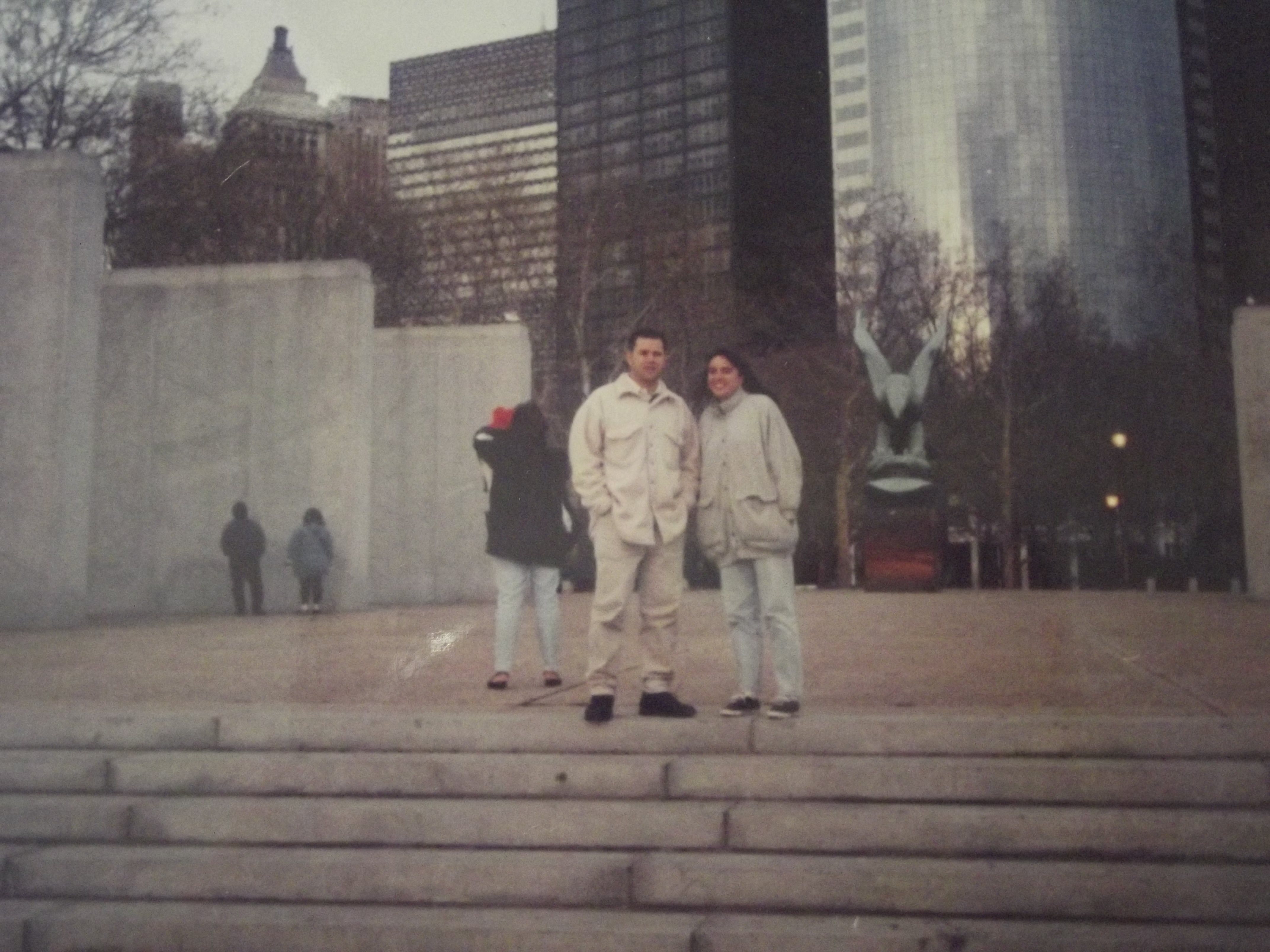
Let me give you some background: David McGee is one of the smartest guys I know. He is also one of the godliest. And he never makes rash decisions. He’s researched cars for close to a year before making a purchase. When he was choosing a seminary, he poured over pamphlets, spoke to every seminary graduate he knew, seeking advice. Whatever the opposite of “spontaneous” is — that’s Dave. And it’s a great thing. God made him cautious, wise. And we balance each other out well because I hardly every think before I make a decision. My gut and a credit card is all I need!
So when we met, Dave was attracted to me, but he was cautious. I was only 19 – a baby. He was 25 – a college graduate. He knew 19-year-olds tended to be fickle and immature. He was at the point where he was ready to find his future wife. And he wanted to be sure he made the right decision. So he watched me. All summer. We worked together at a youth camp. He was one of the Unit Leaders (in charge of a group of counselors), and I was a counselor (not in his unit). His sister conspired to get us thrown together in some activities. Shoot, the whole camp worked on throwing us together. I wasn’t sure I was interested in someone that old, but I had to admire a guy whose Bible was so worn it was held together by duct tape!
That fall, he decided to go to the Word of Life Bible Institute’s (WOLBI) School of Youth, Ministry and Evangelism. He had finished college and he had attended WOLBI’s one-year Bible program the year before me. But he felt God wanted him to study the Bible more, and so he came back. With me. And we hung out. Now WOLBI is super strict, so no couples are allowed to go off campus together or touch at all — not even hold hands. So we spent that fall talking. A lot. That’s a good thing. We really go to know each other – what we liked and didn’t like, what we believed, what we thought God wanted us to do in life. But we didn’t talk about “us.” Didn’t call each other “boyfriend” and “girlfriend” or even (a WOLBI favorite) a “special” friend.
I was getting a little impatient. I mean, we met in JUNE and it was NOVEMBER. I understood cautious, but this seemed excessive! And then he asked me to come home with him. I was so excited! That meant something – we were ready to put the “special” in front of the “friends.” And then he told me he had invited someone else home, too- a friend from school, John, who lived in England and couldn’t go home for the holidays.
“So,” I tried to be as diplomatic as possible. “Do your parents know anything about me?”
“They know you’re coming.”
“Do they think I’m with John or with you?”
“We didn’t talk about it.” He said. “It doesn’t matter.”
It doesn’t matter. Right. But then he said his sister, whom I had known from camp that summer, had been talking to their mom, and she filled her parents in on who I was. Nice.
So I was in Long Island with a guy I was falling hard for and I wasn’t even sure if his parents knew who I was.
Why would he do this? Because I had gotten to know him, I knew it was because he had gotten hurt in the past. He had dated girls and had his heart broken, and he didn’t want that to happen again. His mom had gotten her heart broken, too, when Dave was hurt. So he didn’t want to bring any but “the” one to meet his parents. I knew him asking me to come home was a big deal. But I also knew it was scary for him.
The week ended up being great. Away from the rules of WOLBI, we sat close on the couch, held hands (!), and just had fun. By the time I left, we were official. I think I could have flown home without the aid of an airplane!
Now, eighteen years later, it is a fun story, one we laugh about when we tell our friends. But, I have to say, as impatient as I was, I am glad Dave was so slow. In a time where life is fast, girls and guys are fast, being slow has major advantages. We spent a long time building a foundation of friendship before we began speaking of love (that was still several more months after this story!). That friendship, built on Christ, is what has sustained us for the sixteen years we have been married, through global moves, heartache and hard times. It has allowed to stay together “For better or for worse.”
And now, eighteen years later, it is still one of my fondest Christmas memories!
Dealing With Criticism
I love almost everything about writing. I love being creative, I love working with creative people. I love seeing how my words translate into a cover and how my plots get condensed into a “back of the book blurb.” I love the feel of the computer keys beneath my fingers (though they have to be the right keys – spaced apart, not shoved together, keys that make noise when I hit them).
I don’t love, however, the criticism that comes with being a writer. I am fortunate to have been a teacher before I was a writer. And to have been in ministry before either of those occupations. In ministry, in teaching, and in writing, people feel free to criticize, to point out what you do wrong and what you could do to make it better.

I don’t want to minimize constructive criticism – we all need that desperately. I ask my students every year how I can improve as a teacher. I hope every year that I will do a better job than I did the year before. The same with writing. I want my next book to be better than my last. I want to learn from those who have been writing longer than I and continue to hone this craft. In teaching and in writing, I will never “arrive,” but I do hope to continually improve.
But criticism isn’t always constructive. I’ve gotten stuff like:”This book is terrible,” “Offensive!” “I can’t believe someone published this junk.” The kind that makes me want to throw away my computer, curl into a ball and eat an entire chocolate cake in one sitting.
Even if you’re not a writer (or a teacher or in ministry), you still face criticism. The good kind, coming from people who love you and want to see you be even better than you are now, and the negative kind. So how do you handle it?
First – determine what kind of criticism it is. Is this coming from someone who cares for you? Is it a mom saying, “You are too smart to get a D in math.” Or is it a jerk saying, “You’re the dumbest girl in class?” If it’s the former – listen! I was lazy in school, doing the absolute minimum, especially in my math classes. My parents did everything they could to make me work harder. But I didn’t listen. And I suffered the consequences – being forced to take remedial math classes in college because my skills were so low. Once I applied myself, though, I made A’s — in every math class I took. My parents were right! I was too smart to get a D in math. I wish I had listened to them.
If the criticism isn’t the good kind, if the person giving it doesn’t know you or care about you, isn’t telling you this to make you a better person….ignore them! This is hard, I know. Especially if it’s coming from someone whose good opinion you want. But there are people who thrive on criticizing others. Many times it is because they have been unfairly criticized, they are angry, hurt, and they need to make someone else feel bad to make themselves feel better. These people are to be pitied, to be prayed for. But they are not the kind of people we should give power to. Don’t let their words hurt you or keep you from doing what you want to do, what you feel God has called you to do.
And that’s the bottom line: the only opinion that truly matters is God’s. When we get caught up in what others think, our own thinking is skewed. We can think the worst of ourselves or we can think too highly of ourselves. Neither of those is healthy. We should be content with who we are, and we should be seeking to become more like Christ. We should listen to the voices that matter and tune out the ones that don’t.
The Devil Made Me Do It?
I have a good friend in the medical field who says “I have never met a demon I can’t medicate.” He argues that mental illness is the culprit in cases like last week’s shooting – that people’s minds can be so compromised that they think committing atrocities is justifiable. Others like him agree that with counseling and the right combination of pharmaceuticals, these “demons” can be controlled.
I have other friends who believe that events like last week’s mass murder is a result of demonic activity in people. They argue that all mental illness is a result, not of a compromised mind, but of a Satanically possessed or oppressed mind.
I fall somewhere between these two. I do believe that there are people with legitimate mental illnesses that need medication and counseling and protection. I do not want to return to a time when those with mental illnesses are ostracized and left without help or care. But I also believe Satan is real and active and that he “prowls around like a roaring lion looking for someone to devour.” (I Pt. 5:8). And I believe that “our struggle is not against flesh and blood, but against the rulers, against the authorities, against the powers of this dark world and against the spiritual forces of evil in the heavenly realms.” (Eph. 6:12)
Many people think belief in Satan is primitive, ridiculous. They can accept the idea of a loving God, even a righteous God. But evil personified? They can’t accept that. But the Bible is clear in its discussion of the Evil One: he is real and active. Jesus cast out demons and called out those who were listening to this “father of lies.” The apostles dealt with demons, as well. We don’t see much overt demonic activity here in the states because, I believe, Satan finds greater victory working covertly here. But people who have lived overseas – especially in third-world countries – have seen those possessed by demons, oppressed by demons, and even enamored by demons. Satan’s goal is to keep people from knowing God and surrendering to Him. He will use whatever means necessary to achieve that goal.
I also believe, as I stated in the previous post, that people can choose to do evil. And when they do, they are responsible for that choice. No one should “get away with murder.” People should be held accountable for their actions. I understand that some need a mental facility more than a prison, but no one should be allowed to break the laws of God or man without consequences.
I’d love to hear your perspectives, your experiences. This is a tough issue. But it is one that we should wrestle with, that we should understand. What do you think?