
MY BLOG POSTS
The Lost Art of Following the Rules
I was watching my son play basketball this morning when the youth pastor in charge came to the microphone during half time. He very kindly requested that people not bring food or drinks into the building. I wondered at his having to say it — there were signs posted at every door. The rules were clear. Then I looked next to me. A woman had with her a thermos of coffee. I looked across from me, a player had a sports drink by his feet. And even after the youth pastor finished his request, those drinks remained. The rule was ignored.

Does it really matter? You may ask. That’s a stupid rule. Kids are playing basketball, sweating. They need the electrolytes. Parents are tired from a long work week. They need coffee. I get it.
But here’s the thing: In life, we don’t get to choose which rules to follow and which we don’t. We don’t get to say, “That’s stupid, so I don’t have to do it.” We are not the supreme authority.
But we act that way, don’t we? I don’t like this rule. I think it’s stupid. It inconveniences me.
It may sound extreme. Maybe even legalistic. But I think following rules is important. Not just the “big” rules. Not just the ones we think are worth following, but all the rules.
I believe we honor God when we honor the authorities he has placed over us. Even when we disagree. Even when those authorities enforce rules that annoy or inconvenience us. I believe it helps us to deny ourselves, to be reminded that we don’t always get to do what we want when we want. I believe we are better, stronger, kinder people when we follow rules.
What do you think? Do you think following the rules is important? Are there certain rules that are okay to ignore?
Oh, Be Careful Little Mouth What You Say
If I had a dollar for every time my big, fat mouth has gotten me in trouble, I would be able to buy a private island where I could live isolated from those who I have hurt, offended, or just plain annoyed. You introverts reading this might not understand. Many of you naturally think before you speak and weigh your words carefully before throwing them out there for all to hear. But you extroverts — you know exactly what I’m talking about.
Words can be wonderful. The Proverbs are full of the ways in which words can help, heal, comfort, encourage. I have benefitted from “words fitly spoken” on many, many occasions. I want my words to be like that – refreshing, beautiful, “apples of gold in pictures of silver.”

But words can also be devastating. We all know that sticks and stones hurt far less than words, no matter what the old rhyme says. The wounds that harsh words leave take a long time to heal. I am ashamed to say that I have inflicted wounds like that. And, no matter how badly I felt after those words were out, no matter how much I apologized, I couldn’t erase what was said.
So how do we “guard our tongues” so that what we say is helpful and not hurtful? Jesus said that we speak from the overflow of our hearts. So if we want to speak words that are good, we need to focus our hearts on what is good. Meditate on God’s words, let them fill us so that, when we speak, that is what comes out. When we focus on what we don’t like, who we don’t like, that will come out when we speak.
“May these words of my mouth and this meditation of my heart
be pleasing in your sight,
Lord, my Rock and my Redeemer.” Ps. 19:14
Dining on Devotional Donuts
I love donuts. Chocolate glazed with chocolate icing is my favorite. Mmmm. I like sugar-covered cream-filled donuts, too. But if I were to eat only donuts every day…not only would I have to fill my closet with stretchy pants, but I’d also be miserable! I need proteins, vegetables, grains in my diet. I need solid good-for-me foods to stay healthy.
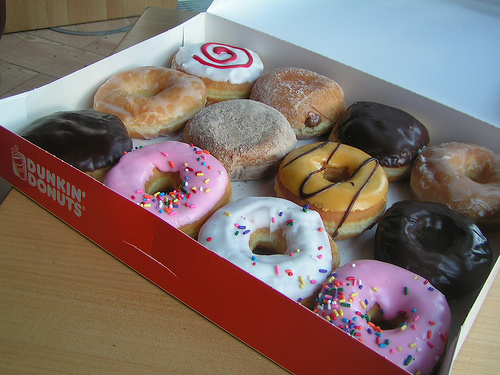
Sometimes, though, in our spiritual lives, we are content with “devotional donuts.” Instead of feasting on the solid meat of God’s amazing word, we maintain a steady diet of devotions that are light and tasty. They make us feel good, but they are easily forgotten and they don’t really help us build the spiritual muscle needed to face life’s challenges.
I know — the Bible is tough. It is confusing. But I also know that students read tough, confusing works all the time. You have to. Your textbooks are tough and confusing. The literature books your English teacher makes you read are tough and confusing. And let’s not even talk about math! I still break out in hives every time I hear “quadratic equation.” But you read them, you study them, because you know it is important to master that material, to get good grades so you can get into a good college and (hopefully!) get a decent job.

So forget the excuses. Ignore them. And study God’s word. Really study it. Go to your local Christian bookstore and find a study that goes through a book of the bible or addresses a biblical topic. I prefer the ones with fill-in-the-blanks – they help me stay focused. There are many wonderful books like that. And they aren’t expensive — usually $15 or less. And the rewards are amazing. Your faith is strengthened, your love for God and for others is strengthened. And you begin to hunger for the “meat” of God’s word even more. Not that the occasional “devotional donut” isn’t still delicious. But your Christian life isn’t filled with those. They are a treat, an appetizer, but not the main course.
So trade in your spiritual stretchy pants for some walking shoes! It is a decision you will never regret.
Why Do Good?
“Doing Good” is part of almost every religion, part of groups on every side of the political landscape; it is part of slogans and campaigns. It is everywhere. Christians don’t have the corner on the “do good” market. But we do have a reason for doing good that is different than anyone else’s. Or, at least, we should.
In one of Jesus’ most famous sermons, he said, “Let your light shine before others, that they may see your good deeds and glorify your Father in heaven.” (Mt. 5:16) So why do we do good? To glorify God and point people to Him.
But, sometimes, I think even Christians forget that. In fact, sometimes, I think Christians fall into the trap of thinking doing good for others means that good will happen to them. They take the idea of “karma” from eastern religions and believe that is a biblical idea. That God will bless you with material things or no disease or no pain if the good you do outweighs your bad.
But that idea cannot be supported by scripture or by experience. Jesus himself was the best man to ever walk this earth. He was Emmanuel – God with us. If anyone “deserved” good, it was this man who healed the sick and cared for the lepers and ate with the outcasts. Yet he was killed. The disciples all faced horrible ends. These were men who loved God and served others with everything they had. I can think of half a dozen people I know, right off the top of my head, who are amazing, wonderful people, people who “deserve” good things. But these people have lost children, lost parents, lost homes, suffered deep hurts, emotionally and physically. All the good these people did did not protect them from hurt and pain.
So why do good? Because it honors God. Because it points people to Him. Because we were created to be part of a community of people who reflects Christ. And what do we get out of it? Wealth that cannot be measured by anything on this earth: Peace that passes understanding. Uncontainable joy. Faith that can withstand storms. Hope in a future that is infinitely better than even the best days we have in the present.